
Terraform drift recovery: stabilize IaC without stalling delivery
Drift grows quietly until applies feel dangerous. This is a recovery plan that restores safe change control without freezing delivery.
- Manual changes patched in production without Terraform.
- Applies are avoided because the blast radius is unknown.
- State is shared across environments or teams.
- Modules are brittle and undocumented.
Drift recovery works when the unsafe control surface becomes visible
Teams stop trusting Terraform when nobody can tell whether the next plan is a routine change or a hidden rollback event.
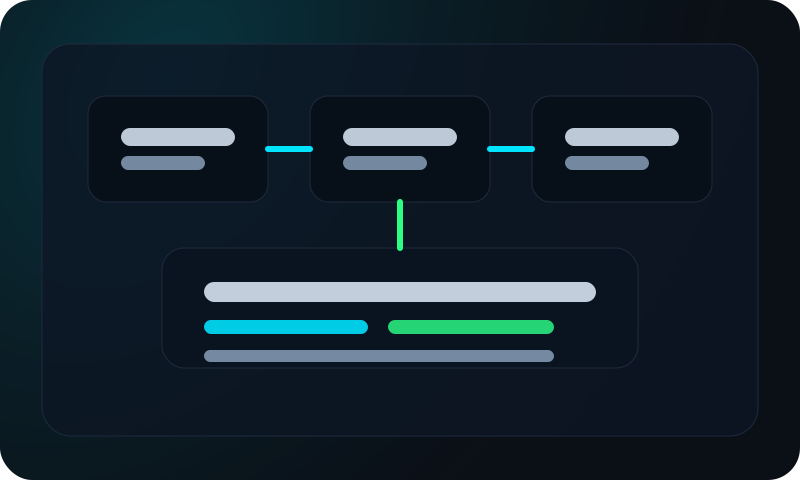
The first useful view shows state boundaries, module coupling, and the places where manual drift keeps turning normal applies into risky change events.
Terraform drift is usually a control problem, not a tool problem. The job is to expose which parts of the estate can change safely now, which need reconciliation first, and which should stop changing entirely until trust returns.
Terraform drift is usually a process failure, not a tooling failure
Drift appears when changes land outside of IaC and nobody can reconcile them safely. It often starts with a hotfix, then becomes a habit. Over time, the state file stops matching reality and teams lose trust.
- Incidents force manual changes that are never reconciled.
- Multiple teams edit infrastructure without a shared review gate.
- Environment strategy mixes shared state and conflicting ownership.
A six-step plan that restores safe applies
Keep delivery moving while you rebuild trust in IaC.
1. Freeze unsafe change
Pause high-risk applies and document the current state reality.
2. Inventory drift
Identify manual changes, unknown resources, and unmanaged dependencies.
3. Split ownership
Separate environments and reduce cross-team coupling in state.
4. Rebuild modules
Simplify critical modules and document intent and constraints.
5. Re-introduce safe applies
Use targeted plans and smaller blast radius changes.
6. Create guardrails
Make off-path changes visible and expensive again.
Use a short drift readout before you touch state
The first review pass should be enough to tell whether the next move is reconciliation, refactor, or containment.
Signal                              First move
Manual prod patch found              Record it and map it back into IaC
Shared state lock repeats            Split ownership before bigger change
Unknown plan delta                   Compare runtime reality to state and code
Module too coupled to test safely    Break sequence into smaller change sets
Why this helps
- Reduces the urge to "just apply and see what happens."
- Keeps the team focused on the highest-risk control failures first.
- Makes follow-through easier for platform owners after the initial response.
Habits that keep drift from returning
- Pre-apply checklists and ownership gates.
- Change reviews that include runtime impact, not just diffs.
- Runbooks for emergency changes with reconciliation steps.
- Weekly drift checks on critical modules and environments.
Related pages to continue drift recovery
If applies feel risky, request an Infrastructure Review.
We can stabilize IaC, pipelines, and delivery without slowing your team.