
Infrastructure review checklist for SaaS teams under pressure
A fast decision guide for when to request a review and what to prepare so the response is actionable.
- Delivery teams stuck in fire-fighting mode.
- Leaders who need clarity before the next audit or launch.
- Platform owners facing drift, rollbacks, or unclear risk.
The useful output is a concrete first artifact, not a vague assessment
If a review cannot show the risky systems, the failure chain, and the next safe move, it is not ready to guide real decisions.
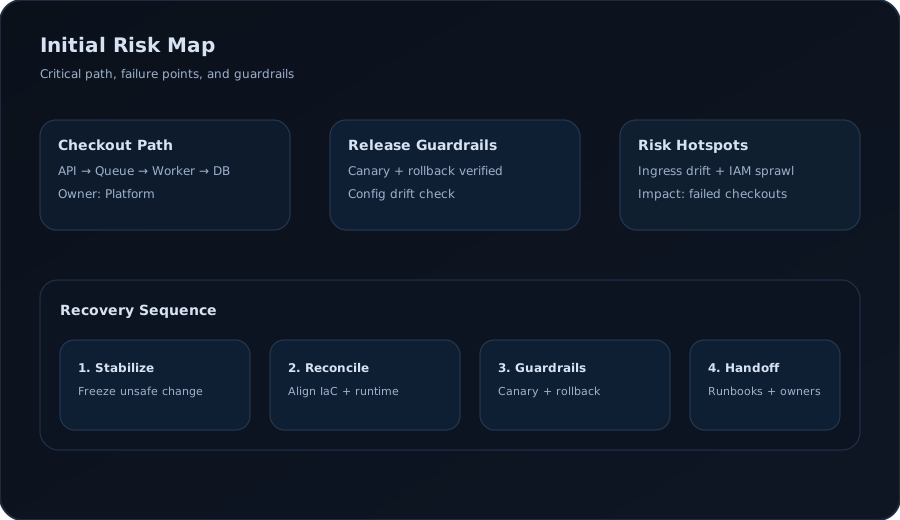
The first retained view should connect business impact, failure pressure, blocked owners, and the safest sequence for response.
The reason teams request a review is not to collect observations. It is to replace vague concern with a bounded response path they can act on within days, not weeks.
Map the critical path before you change anything
If you cannot trace how traffic, identity, data, and deploys flow, any fix is a guess.
Start with the revenue path
Document the user journey that makes money, then trace the services, queues, data stores, and integrations that keep it alive. This path will anchor the review and prevent random tuning.
List the top failure modes
- Release failures and rollbacks that are becoming normal.
- Latency spikes tied to unclear dependencies.
- Terraform changes that no one wants to apply.
- Manual fixes that skip IaC and silently create drift.
Signals that a review is urgent
If two or more of these are true, you should request a review now.
- Deploys are delayed because nobody trusts the pipeline.
- Incidents repeat and root causes feel hazy.
- Infra cost spikes are unexplained or blamed on growth.
- Security or compliance pressure is rising without evidence.
- Knowledge is stuck in a few people and burnout is visible.
Prepare a small review pack
You do not need perfect documentation. You need the right signals.
What to send first
Send:
- architecture or service map
- environments and ownership notes
- recent incident or release pressure
- Terraform / CI/CD pain points
- what feels risky right now
What not to send
- Credentials or secrets in the first message.
- Long internal documents nobody can summarize.
- Every historical issue instead of the current blocked path.
System artifacts
Architecture diagram, service list, environments, Terraform repo, CI/CD pipelines, and IaC state notes.
Operational signals
Recent incidents, deploy history, cost anomalies, known pain points, and ownership map.
Know what a strong review outputs
A real review gives you clarity, not just observations.
- A risk map that ties failures to business impact.
- Clear recovery sequencing that avoids destabilizing changes.
- Delivery guardrails that reduce rollback pressure.
- Evidence for leadership, audits, or investment decisions.
Related pages to continue your review path
If you want clarity in 1-2 weeks, request the review.
We respond within 24 hours with next steps.